Projects / Master's coursework
S&P 500 forecasting
256 trainings, none beat a linear model
Summary
Sixteen architectures, dense, recurrent, convolutional and hybrid, predicting the returns of 23 S&P 500 stocks: 256 trainings in all. None beat a linear regression, and the write-up explains why: the returns are close to noise, so every network ends up predicting the mean. Team of 3.
The task
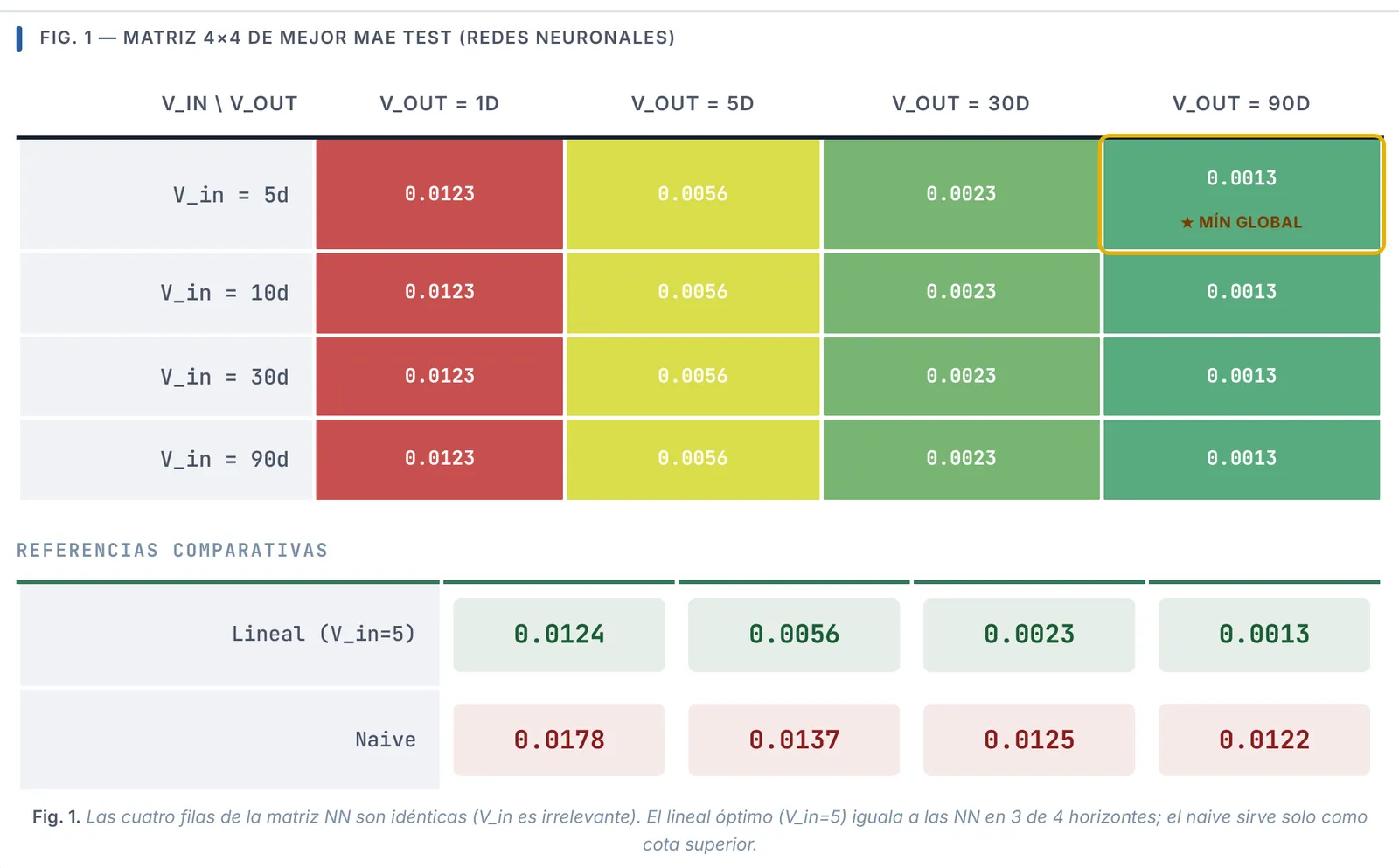
Predict the average future log return of 23 S&P 500 stocks from their past returns, over 16 combinations of input and output windows from 1 to 90 days, scored by MAE. We trained sixteen architectures, dense, recurrent, convolutional and hybrid: 256 trainings in all.
Results
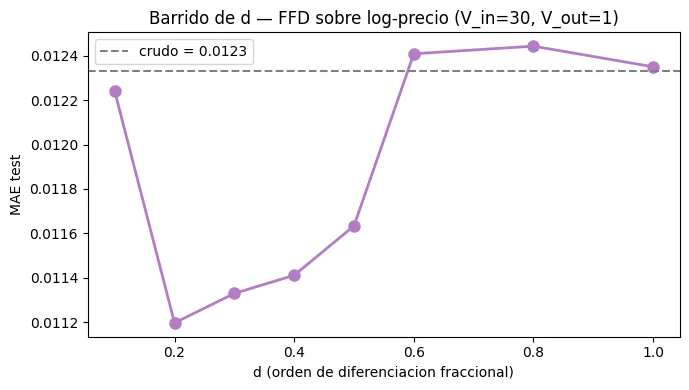
None beat a linear regression. Every network converged to the same error in every window, because returns are close to white noise and the best answer is the mean. The only real gain came from fractional differentiation, which cut the one-day error by 8.9%.
Figures